


Contents
Scroll to:
https://doi.org/10.37489/2588-0519-GCP-0017
EDN: CMKUCV
Scroll to:
Background. Digitalization and the introduction of information technologies are transforming modern clinical research practices. Digital labeling of medicines ensures transparency and traceability of circulation, minimizes human errors in record-keeping, and increases the reliability of real-world clinical practice data in the Eurasian Economic Union (EAEU). These aspects are significant for the accelerated registration of medicines, amendments to the registration dossier, and the evaluation of post-registration monitoring data, including information on the results of any use of the investigational product.
Objective. The purpose of this study is to identify the features of the circulation of labeled drugs in clinical trials, using calcium hydroxynicotinoylglutamate as a case study.
Results. Clinical studies are conducted in medical institutions (both public and private), and the investigational drugs may or may not be included in the Russian Federation's digital marking system. The Rules of Good Clinical Practice provide for organizational measures during clinical studies for all participants. An open-label, two-stage comparative study was conduct ed in healthy volunteers. The pharmacokinetic characteristics, safety, and tolerability of hydroxynicotinoylglutamate calcium (5 mg/ml) were studied following intramuscular and intravenous administration. The logistics of the investigational drug are described across all business processes of the medical institution's inventory and accounting system, from acceptance at the research center to accountability and return to the sponsor.
Conclusion. Digital technologies and the labeling of investigational drugs optimize control and accounting during clinical trials. At the same time, further study is needed on the integration of digital tools into the accounting systems of medical organizations.
Sokolova O.V., Lileeva E.G., Isaeva I.Yu., Alekseeva K.S. Circulation of labeled medicinal products in clinical trials using digital tools. Kachestvennaya Klinicheskaya Praktika = Good Clinical Practice. 2026;(1):89-96. (In Russ.) https://doi.org/10.37489/2588-0519-GCP-0017. EDN: CMKUCV
Modern clinical research practice is undergoing significant changes under the influence of digitalization and the introduction of information technologies [1]. In the medical community of Russia, the EAEU member states, and other countries, the use of real-world clinical practice data to improve the quality and reliability of results is being discussed [2, 3].
Legal regulation is developing in parallel with technical transformations [4]. In this regard, digital tools in clinical trials are becoming an integral part of data collection, management, and statistical analysis, particularly in reflecting the movement, accounting, and control of investigational medicinal products. Traditional paper‑based data collection methods are being replaced by digital ones, which optimizes processes [5].
Digitalization is especially important in the accelerated registration of medicinal products and in amending registration dossiers to analyze the benefits and risks of these procedures, highlighting the need for enhanced subsequent monitoring and collection of real-world clinical practice results [6, 7]. Also, for registered medicinal products, post‑registration monitoring data, including information on the results of any use of the investigational product, are significant [8–10].
One such tool is the digital labeling of medicinal products, which ensures transparency and traceability of drug movement, minimizes risks of accounting errors, and increases the accuracy of investigational drug control [4].
The above determined the aim of this study — to identify the features of the circulation of labeled medicinal products in clinical trials using calcium hydroxynicotinoylglutamate as a case study.
The research methodology included a systematic approach to studying the regulatory framework for clinical trials, analysis of scientific publications on the organization of drug supply for clinical trials, business processes of drug circulation in clinical trials, and electronic document management (EDM). Content analysis, mathematical and statistical methods, and paired sample comparison using the Wilcoxon t‑test were applied.
The study materials included regulatory legal acts in the field of public health of the Russian Federation and the EAEU, data from official websites of the State Register of Medicines (GRLS), the Unified Register of Registered Medicines of the EAEU, EDM data from the medical organization’s inventory and accounting systems, the contract with the sponsor, and the study protocol. The selection of the investigational drug, the category of volunteers, and the study site were determined by the sponsor and formalized in the contract [11].
Object of the study — the circulation of medicinal products during clinical trials in a medical organization (investigator site).
Subject of the study — the features of organizing business processes for the circulation of investigational medicinal products in clinical trials using digital tools.
The legal framework for conducting clinical trials is established both in Russia and within the EAEU. It has been shown that clinical trials are conducted in accordance with the EAEU Rules of Good Clinical Practice [9]. According to Russian legislation, a post‑registration clinical trial of a medicinal product for medical use is defined as a clinical trial conducted by the manufacturer of the medicinal product, whose civil circulation is carried out after state registration or registration, for additional collection of data on its safety and efficacy, as well as to expand the indications for use of this medicinal product and to identify adverse reactions of patients to its action [4, 12].
Consequently, after registration of a medicinal product, Phase IV development begins to optimize its use. Such studies scientifically substantiate the study of additional drug interactions and are conducted for the following purposes:
to establish the safety of the medicinal product for healthy volunteers and/or its tolerability by healthy volunteers, except for such studies of medicinal products manufactured outside the Russian Federation;
to select optimal dosages of the medicinal product and treatment course for patients with a particular disease, optimal doses and vaccination schedules for immunobiological medicinal products in healthy volunteers;
to establish the safety and efficacy of the medicinal product for patients with a particular disease, and the preventive efficacy of immunobiological medicinal products for healthy volunteers;
to study the possibility of expanding indications for medical use and to identify previously unknown adverse effects of registered medicinal products [4].
Clinical trials, including post‑registration trials, are conducted in Yaroslavl Region in several large medical organizations and medical centers that have the necessary equipment and qualified personnel. The general scheme is shown in the Figure.
It should be noted that investigational drugs are studied in public or private medical organizations and may or may not be included in the Russian Federation’s digital labeling system [13].
The Rules of Good Clinical Practice prescribe organizational measures for conducting clinical trials for all participants [9, 14].
The clinical trial organizer provides the medical organization with the current version of the clinical trial protocol and the investigator’s brochure before signing the contract with the medical organization for conducting the clinical trial and sets a time for reviewing the provided information. It then transfers the investigational drugs, comparator products, and placebo that have appropriate quality indicators and are, if necessary, coded for blinding purposes. The primary and secondary packaging of medicinal products intended for clinical trials may also be marked with the inscription: “For clinical trials”.
In turn, the medical organization is responsible for accounting for the received investigational drugs, their use, and their return to the organizer. For this purpose, the medical organization appoints a responsible investigator, a pharmacy worker, a pharmacist, or another employee of the medical organization.
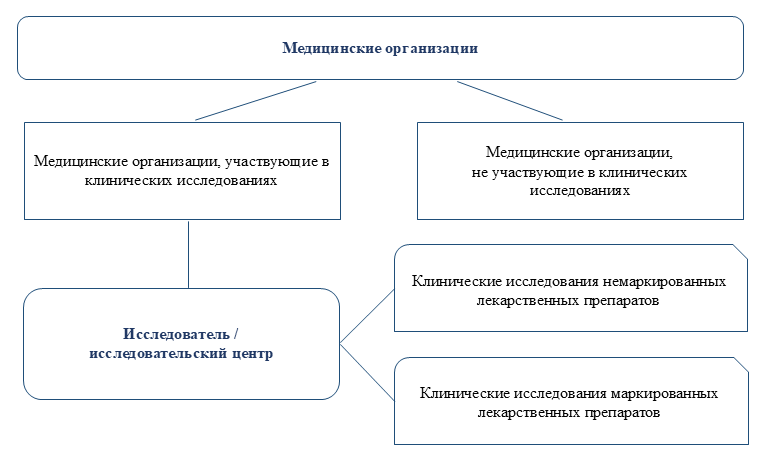
Fig. Medical organizations participating in clinical trials
The activities of the medical organization’s pharmacy within the framework of clinical trials should aim to maintain the investigational drug in proper conditions in accordance with the sponsor’s instructions. The pharmacy worker (pharmacist) records the supply of drugs to the research center, their actual quantity at the center, use by each subject, as well as the return to the sponsor or other disposal of unused investigational drugs. Accounting records must include dates, quantities, batch (series) numbers, expiry dates (where applicable), and unique codes of the investigational drugs and study subjects.
The representative of the medical organization conducting the clinical trial is obliged to maintain study documentation, as well as records confirming receipt of the investigational drugs in doses provided for by the protocol and contract.
In March 2025, an open‑label, two‑stage comparative study was conducted at the Clinical Hospital No. 2 of Yaroslavl Region. To study the pharmacokinetics, safety, and tolerability in healthy volunteers, and consequently the business processes of drug circulation in clinical trials, a solution of calcium hydroxynicotinoylglutamate 5 mg/ml was provided.
An analysis of official websites for the registration of medicinal products in the Russian Federation and the EAEU was performed; summary data on the investigational drug are presented in the Table.
It was established that the investigational drug with the INN calcium hydroxynicotinoylglutamate has to date passed state registration both in the Russian Federation and in the EAEU with one trade name and is not included in the list of Vital and Essential Drugs.
When receiving the investigational drug included in the Russian Federation’s digital labeling system, the head of the medical organization’s pharmacy performed all drug circulation processes. Delivery accuracy and confirmation of receipt with date, signature, and its full name in the documentation were duplicated on paper (a copy of the documents is stored in the Investigator’s File). Storage and dispensing of the investigational drug to the investigator were carried out in accordance with current regulatory documents and local acts of the medical organization.
Further, during the study, the pharmacokinetic characteristics of the investigational drug calcium hydroxynicotinoylglutamate were assessed following intramuscular and intravenous administration in healthy volunteers [15–31]. Non‑parametric comparison revealed statistically significant differences (p <0.05 using the Wilcoxon test for paired samples) for all pharmacokinetic parameters except AUC0‑t and AUC0‑∞. For these parameters, a parametric method (paired t‑test after logarithmic transformation of the data) was additionally applied, which did not reveal significant differences. Thus, the drug calcium hydroxynicotinoylglutamate demonstrates similar values of the area under the concentration‑time curve for both routes of administration.
The bioavailability of calcium hydroxynicotinoylglutamate following intramuscular administration, calculated on the basis of AUC, was not statistically different from its bioavailability following intravenous administration. The study confirmed the comparability of pharmacokinetic parameters after intramuscular and intravenous administration of the drug, indicating equivalence of these routes of administration.
As part of the Phase IV clinical trial, the pharmacokinetics of calcium hydroxynicotinoylglutamate after intramuscular and intravenous administration in healthy volunteers were evaluated. Non‑parametric analysis revealed significant differences in most parameters (p <0.05), except for AUC0‑t and AUC0‑∞, for which a t‑test after logarithmic transformation was used. The results showed stability of AUC for both administration routes, confirming equivalence of the methods. Analysis of blood serotonin levels showed a significant increase: from 125.31 to 138.88 ng/ml (+10.8%) after 24 hours. In 15% of participants with low serotonin levels, levels normalized, and in all subjects, serotonin levels reached the physiological norm (70–170 ng/ml). Intravenous administration of the drug demonstrated a beneficial effect on the serotonergic system, which is important in cases of serotonin metabolism disorders.
The investigator was responsible for reporting on the investigational product (IP), including the receipt and expenditure of the investigational drug, as well as maintaining accounting documentation in accordance with current legislation and approved standard operating procedures conducted in the structural unit of the medical organization.
The dispensing of the investigational drug to the medical post strictly of the structural unit was recorded in the study reporting forms:
• confirmation of delivery of the investigational drug to the research center (medical organization);
• accounting of each dose of the investigational drug used.
Unused investigational drug was not subject to disposal, was not used for purposes other than those of this study, and upon completion, all unused investigational drug was returned to the Sponsor using return documents.
The use of digital business processes in the inventory and accounting systems of a medical organization using EDM allows for a reduction in receipt and dispensing times, which is necessary to meet clinical trial rules and timelines.
Digital labeling allows the selection of investigational drug packages without additional markings, since the study’s EDM includes unique digital codes designated “For clinical trials” in the Federal State Information System of Drug Labeling. In turn, this makes it possible to assign a specific package of the investigational drug to a specific volunteer, which is convenient for investigating adverse reactions that may arise, taking a short amount of time.
Since the investigational drug with the INN calcium hydroxynicotinoylglutamate has successfully passed preclinical and clinical trials of Phases I, II, III, and IV (post‑registration), during which its efficacy and safety were demonstrated and proven for intravenous and intramuscular administration, this allows the drug to be in civil circulation.
However, despite the advantages of digital technologies, the issues of organizing the circulation of investigational drugs in medical organizations during clinical trials are poorly understood. There are difficulties in integrating digital solutions with traditional business processes, as well as regulatory and technical barriers that require systematic analysis and optimization.
| Criterion | Characteristic |
|---|---|
| International nonproprietary name | Calcium hydroxynicotinoylglutamate |
| Dosage form | Solution for intravenous administration 5 mg/ml |
| Pharmacotherapeutic group | Psychoanaleptics; psychostimulants, agents used for attention deficit hyperactivity disorder and nootropic agents; other psychostimulants and nootropic agents |
| Anatomical Therapeutic Chemical classification | N06BX |
| Indications for use | Chronic cerebrovascular disorder |
| Storage conditions | In a light‑protected place at a temperature not exceeding 25 °C. Do not freeze. Keep out of reach of children. |
| Shelf life | 3 years |
1. Pharmaceutical industry 4.0. Digital transformation / edited by A.L. Khokhlov, N.V. Pyatigorskaya. – Moscow: OKI Publishing House, 2025. – 312 p.: color ill. 37. ISBN 978-5-4465-4468-4]. Режим доступа: https://izdat-oki.ru/farmacevticheskaya-otrasl-4-0-cifrovaya-transformaciya.
2. Sikachev V.V., Gorin V.V., Kolbin A.S., Belousov D.Yu. Legal aspects of conducting real-world studies. Kachestvennaya Klinicheskaya Praktika = Good Clinical Practice. 2020;(5):64-69. (In Russ.)
3. Andreev D.A. Evolution of clinical trials: digital tools and quality control in an international perspective: an expert review – Electronic text data. – Moscow: State Budgetary Institution “Research Institute of Health Protection of the Russian Federation, Department of Health of the City of Moscow”, 2025. (In Russ.)
4. Federal Law of April 12, 2010 No. 61-FZ "On the Circulation of Medicines" (In Russ.)
5. Kolbin A.S., Borzova M.A., Belousov D.Yu., Kalinichenko V.V. Resolution based on the results of the V annual scientific-practical conference "RWD/RWE. Possible and real". Real-World Data & Evidence. 2024;4(3):3-12. (In Russ.)
6. Ponomareva EA. Assessment of risks and benefits during accelerated drug registration. Pharmacy. 2020; 2:24-29. (In Russ.)
7. Nefidova O. G., Babaskin D. V., Litvinova T. M., et al. Rules for registration and examination of medicines within the Eurasian Economic Union: assessment of key changes. Medical and Pharmaceutical Journal Pulse. 2023; 25(10):124–135 (In Russ.).] DOI:10.26787/nydha-2686-6838-2023-25-10-124-135
8. Decision of the Council of the Eurasian Economic Commission dated 03.11.2016 No. 78 "On the Rules for the registration and examination of medicines for medical use." (In Russ.)
9. Decision No. 79 “On approval of the Rules of Good Clinical Practice of the Eurasian Economic Union” dated November 3, 2016. (In Russ).
10. Kurbanov R.D., Trigulova P.Kh. The possibility of using electronic medical
11. records for clinical observation. Eurasian heart journal. 2021;(2):78-82. (In Russ.) DOI: 10.38109/2225-1685-2021-2-78-82.
12. Regulation (EU) No 536/2014 of the European Parliament and of the Council on clinical trials of medicinal products intended for human use and repealing Directive 2001/20/EC. Annex VI. (In Russ.)].
13. GOST R 52379-2005. National standard of the Russian Federation. Good clinical practice (approved by Order of Rostekhregulirovanie dated September 27, 2005, No. 232-st). (In Russ.)
14. Decision of the EEC Council of September 27, 2023 No. 108 “On the labeling of medicinal products with identification means”, subparagraph e) of paragraph 2. (In Russ.)
15. Recommendation of the Board of the Eurasian Economic Commission dated July 17, 2018 No. 11 "On the Guidelines on General Issues of Clinical Trials". (In Russ.)
16. Goloveva AG, Zakharov VV. The etiology, manifestations, and therapy of chronic cerebrovascular diseases. Nevrologiya, neiropsikhiatriya, psikhosomatika = Neurology, Neuropsychiatry, Psychosomatics. 2020;12(5):84–91. (In Russ.)
17. Levin OS. Predementia neurocognitive impairment in the elderly. S.S. Korsakov Journal of Neurology and Psychiatry. 2019;119(9-2):10-17. (In Russ.)] doi: 10.17116/jnevro201911909210.
18. Kulesh AA,
19. Emelin AY, Bogolepova AN, et al. Clinical manifestations and issues of diagnosis of chronic cerebrovascular disease (chronic cerebral ischemia) at an early (pre-dementia) stage. Nevrologiya, neiropsikhiatriya, psikhosomatika = Neurology, Neuropsychiatry, Psychosomatics. 2021;13(1):4-12.
20. Cannistraro RJ, Badi M, Eidelman BH, et al. CNS small vessel disease: A clinical review. Neurology. 2019 Jun 11;92(24):1146-1156. doi: 10.1212/WNL.0000000000007654.
21. Graff-Radford J. Vascular Cognitive Impairment. Continuum (Minneap Minn). 2019 Feb;25(1):147-164. doi: 10.1212/CON.0000000000000684.
22. Granzotto A, Canzoniero LMT, Sensi SL. A Neurotoxic Ménage-à-trois: Glutamate, Calcium, and Zinc in the Excitotoxic Cascade. Front Mol Neurosci. 2020 Nov 26;13:600089. doi: 10.3389/fnmol.2020.600089.
23. Motin VG, Kiselev AV, Stovbun IS, et al. N-(5-Hydroxynicotinoil)-L-Glutamic Acid Calcium Salt Modifies Responses of Rat Hippocampal CA1 Pyramidal Neurons during Orthodromic Stimulation. Bull Exp Biol Med. 2018;165(1):27-30. Doi: 10.1007/s10517-018-4091-0.
24. Kiselev AV, Vedenkin AS, Stovbun IS, et al. Calcium Salt of N-(5-Hydroxynicotinoyl)-L-Glutamic Acid Weakens Depressive-Like Behavior and Parkinsonian Syndrome in Experiment on Rodents. Bull Exp Biol Med. 2019;168(1):48-51. Doi: 10.1007/s10517-019-04643-5.
25. Motin VG, Kiselev AV, Stovbun IS et al. N-(5-hydroxynicotinoyl)-l-glutamic acid calcium salt modifies responses of rat hippocampal ca1 pyramidal neurons during orthodromic stimulation. Bull Exp Biol Med. 2018;165(1):34–37. Doi: 10.1007/s10517-018-4091-0.
26. Kiselev AV, Vostrikova EV, Kalinina TS, Stovbun SV. A randomized, double-blind, placebo-controlled study of the efficacy and safety of ampasse in the treatment of chronic cerebral ischemia. S.S. Korsakov Journal of Neurology and Psychiatry. 2019;119(4):21-25. (In Russ.)
27. Skoromets AA, Kotov SV, Voronkov PB, et al. Efficacy and safety of treatment with ampasse: the results of a randomized, double-blind, placebo-controlled trial in patients with chronic cerebrovascular disorders. S.S. Korsakov Journal of Neurology and Psychiatry. 2021;121(5):26-32. (In Russ.)
28. Zhitkova YuV, Gasparyan AA, Saihunov MV, et al. Observational study of the efficacy and safety of the drug Ampasse in patients with moderate cognitive impairment in chronic cerebral ischemia. S.S. Korsakov Journal of Neurology and Psychiatry. 2023;123(10):75-80. (In Russ.)
29. Quinan V, Dugar A, Bauer D. Long Term Potentiation in Mouse Hippocampal Slices in an Undergraduate Laboratory Course. J Undergrad Neurosci Educ. 2019 Jun 30;17(2):A111-A118.
30. Киселев А.В., Стовбун С.В., Сергиенко В.И. Изучение ноотропных эффектов D- и L-изомеров N-(5-гидроксиникотиноил)-глутаминовой кислоты. Вестник МГОУ. Серия «Естественные науки». 2011;2:47-49 [Stovbun S, Kiselev A, Sergienko V. Experimental study of nootropic and neuroprotective effects of calcium n-(5-hydroxynicotinoil)-L-glutamate. Bulletin of the Moscow region State University. Series Natural Sciences. 2011;2:83-93. (In Russ.)].
31. Kotov SV, Borisova VA, Slyunkova EV, et al. Dynamics of recovery of cognitive deficit in patients in the early recovery period of ischemic stroke. S.S. Korsakov Journal of Neurology and Psychiatry. 2021;121(11):26-32. (In Russ.)
32. Belskaya G.N., Sakharova E.V., Kiryanova E.A. et al. Possibilities of neuroprotective therapy for patients with chronic cerebral ischemia. Neurology and neurosurgery Eastern Europe. 2024;14(2):156-163.
33. Kotov SV, Kiselev AV, Isakova EV, et al. The effect of the start date of cognitive rehabilitation after ischemic stroke on the level of recovery. S.S. Korsakov Journal of Neurology and Psychiatry. 2023;123(8-2):77-83. (In Russ.)
Olga V. Socolova — Cand. Sci. (Pharm.), Associate Professor, Associate Professor at Department of Management and Economics of Pharmacy
Yaroslavl
The authors state that there is no conflict of interest
Elena G. Lileeva — Cand. Sci. (Med), Head of the Basic Department of Innovative Pharmacy, Associate Professor of the Department of Pharmacology and Clinical Pharmacology
Yaroslavl
The authors state that there is no conflict of interest
Ilona Yu. Isaeva — head of pharmacy, GBUZ YAO «Ambulance Station and Disaster
Yaroslavl
The authors state that there is no conflict of interest
Kseniya S. Alekseeva — teacher Department of Management and Economics of Pharmacy
Yaroslavl
The authors state that there is no conflict of interest
Sokolova O.V., Lileeva E.G., Isaeva I.Yu., Alekseeva K.S. Circulation of labeled medicinal products in clinical trials using digital tools. Kachestvennaya Klinicheskaya Praktika = Good Clinical Practice. 2026;(1):89-96. (In Russ.) https://doi.org/10.37489/2588-0519-GCP-0017. EDN: CMKUCV
НАШИ КНИГИ



Другие журналы
"Издательства ОКИ"


ПАРТНЕРЫ

 Email this article (Login required)
Email the author (Login required)
Email this article (Login required)
Email the author (Login required) 121357, Moscow, st. Vatutina, 4, building 2, apt. 22
LLC Publishing House OKI
Tel. +7 (926) 568-17-35
e-mail: clinvest@mail.ru


