


Contents
Scroll to:
https://doi.org/10.37489/2588-0519-GCP-0016
EDN: NKOAQU
Scroll to:
Background. In recent decades, there has been an increase in the incidence and prevalence of inflammatory bowel diseases (IBD).
Objective. To analyze data from the IBD patient registry in Primorsky Region.
Methods. We established a hospital-based registry of IBD patients in Primorsky Region, including those with ulcerative colitis (UC) and Crohn's disease (CD). Data from 682 patients (UC: 464, CD: 218) were analyzed.
Results. The UC: CD ratio was 2.1:1. The male-to-female ratio was 1.26:1 for UC and 1:1.03 for CD. The mean age of patients was 46.3 years for UC and 45.8 years for CD. The mean age at disease onset was 39.2 years for UC and 37.5 years for CD. The high est number of cases was in the 18–40 age group. The time from symptom onset to diagnosis was less than 2 years in 95.4 % of UC patients and in 84.4 % of CD patients. A significant proportion of UC patients had left-sided (39 %) and extensive (53 %) colitis, while CD most frequently involved the colon (67 %). Extraintestinal manifestations (EIMs) were present in 33.6 % of all IBD patients, being more common in CD (47.1 %) than in UC (27.2 %). Analysis of pharmacological therapy showed that 5-ASA drugs were used by 87 % of UC and 44.5 % of CD patients. Thiopurines were used by 35.5 % of UC and 59.6 % of CD patients. In total, 121 patients (17.75 % of the IBD cohort) in Primorsky Region were receiving targeted therapy.
Conclusion. The IBD patient registry is an effective tool for pharmacoepidemiological and pharmacoeconomic analyses. It enables the collection of objective epidemiological data and supports planning for drug provision.
Moskalenko A.S., Eliseeva E.V., Chesnokova O.V., Perelomova O.V. Registry of patients with inflammatory bowel diseases: clinical, demographic and pharmacoepidemiological aspects. Kachestvennaya Klinicheskaya Praktika = Good Clinical Practice. 2026;(1):78-88. (In Russ.) https://doi.org/10.37489/2588-0519-GCP-0016. EDN: NKOAQU
Inflammatory bowel diseases (IBD) are chronic autoimmune progressive diseases, including ulcerative colitis (UC) and Crohn’s disease (CD). Over the past decades, the incidence and prevalence have been increasing, making the problem urgent worldwide. To date, the etiology of IBD is not fully understood, but the immune-mediated pathogenesis of the disease has been relatively well studied. Current drug therapy regimens for IBD include immunosuppressive agents and targeted therapies, which act on the main pathogenetic pathways. Given the need for long-term, often lifelong, anti-relapse treatment, therapy selection is carried out individually, taking into account tolerability, efficacy, safety profile of medications, and prediction of possible adverse events.
Both nosologies, UC and CD, are socially significant; the main cohort of patients is young, working-age, reproductive-age individuals belonging to the category of “chronically ill”, requiring frequent hospitalizations and having disability [1].
In Primorsky Region (PR), according to the data of the PR State Autonomous Healthcare Institution “Medical Information and Analytical Center”, the prevalence of Crohn’s disease in 2022–2024 was 34.7 cases per 100,000 population, and the prevalence of ulcerative colitis was 72.9 cases per 100,000 population.
The International Organization for the Study of IBD (IOIBD) divides the goals of modern IBD therapy into short-term, medium-term, and long-term goals. According to the STRIDE II (Selecting Therapeutic Targets in Inflammatory Bowel Disease) strategy adopted in 2021 [2], short-term goals (reduction of disease symptoms, normalization of serum and fecal inflammatory markers) are steps towards achieving long-term goals. Long-term goals include endoscopic healing and, as an addition, histological remission in UC and transmural healing in CD [2].
In accordance with Russian and international clinical guidelines, the treatment regimens for IBD use expensive targeted and immunosuppressive therapy, which necessitates the development of information systems for data collection in order to assess real-world data on the epidemiology of IBD, as well as efficacy and safety of therapy, long-term outcomes of the disease and treatment, cost-effectiveness of therapy, and other parameters.
A registry is an organized system for collecting and storing standardized information about patients [1]. Maintaining a registry and calculating the registry-based need is the basis for accounting of drug supply, potential budget burden, including within the framework of the Territorial Program of State Guarantees.
The aim of our study was to analyze data from the IBD patient registry of Primorsky Region, studying clinical and demographic characteristics and medical status.
The hospital-based registry includes IBD patients from Primorsky Region, both with previously established diagnosis and those newly diagnosed with UC or CD. To fill the PR IBD registry, a special patient chart was developed with a list of key questions concerning demographic and social characteristics, disease course features, complications, and treatment options for UC and CD. Data collection was carried out from August 2022 to February 2025 inclusive. During the registry filling, we excluded patients with undifferentiated colitis, microscopic colitis, terminal ileitis of unspecified etiology, patients residing in another region of the Russian Federation or those who moved to another region in 2022–2025. All IBD patients signed an informed consent for the processing of personal data and inclusion in the PR IBD registry.
Based on the available data, a depersonalized database of IBD patients in PR was registered (data from 682 patients (UC 464, CD 218) of Primorsky Region), Certificate No. 2025621674 dated April 16, 2025.
The study of differences between discrete qualitative variables was performed using contingency table analysis with calculation of Pearson’s chi‑square (χ²) test. The critical value of the statistical significance level (p) for testing null hypotheses was set at 0.05.
Epidemiology of IBD according to the PR IBD registry. As of February 10, 2025, the hospital-based registry of IBD patients of Primorsky Region (hereinafter referred to as the PR IBD registry) included and analyzed data from 682 patients with an established diagnosis of IBD, of which 464 had UC (68.04%) and 218 had CD (31.96%). The UC:CD ratio was 2.1:1.
IBD patients living in cities of PR – 556 people (81.5%), in villages – 126 (18.5%), which is comparable to the urban and rural population numbers in the region. Women with IBD in the registry – 366 (53.7%), men – 316 (46.3%). The male-to-female ratio for UC and CD is shown in Fig. 1. The age of patients with UC in the PR IBD registry ranged from 18 to 85 years, mean age 46.3 years (standard deviation = 14.7 years); CD – from 18 to 84 years, mean age 45.8 years (standard deviation = 15.2 years).
Disability as of 2025 is present in 34.8% of IBD patients included in the registry. The proportion of disabled among patients with CD was 37.2% (81 people), with UC – 33.6% (156 people) (no statistically significant differences, p >0.05).
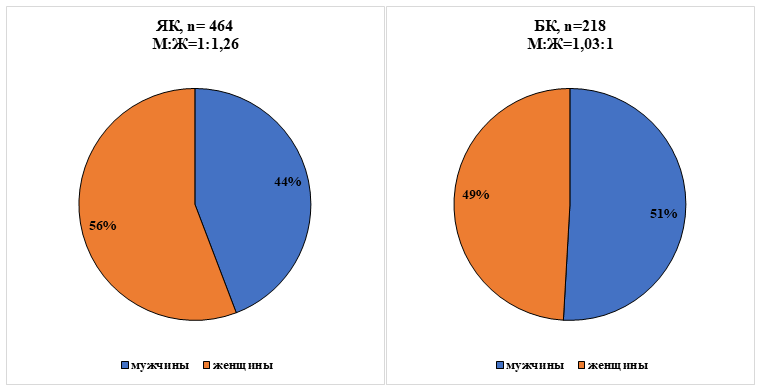
Fig. 1. The ratio of men and women with inflammatory bowel diseases in the Primorsky Region registry of inflammatory bowel diseases with ulcerative colitis (A) and Crohn’s disease (B)
Figure captions:
A: UC, n=464, M:F = 1:1.26 (men 44%, women 56%).
B: CD, n=218, M:F = 1.03:1 (men 51%, women 49%).
Disease onset: age and time to diagnosis. The mean age of IBD onset according to the PR IBD registry was 39.2 years for UC and 37.5 years for CD, which corresponds to the global trend [1–6]. The distribution of UC and CD patients by sex and age at disease onset is shown in Fig. 2. In UC, there were no statistically significant differences in incidence between men and women by age. The highest number of patients of both sexes with UC was observed in the 18–40 age group. Notably, the onset of CD predominated in men aged 18–40 and in women aged 41–70 with significant statistical significance (p <0.001).
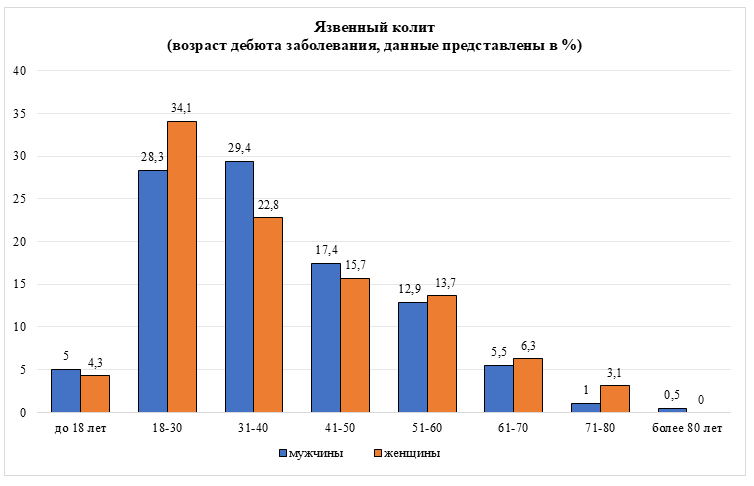 | 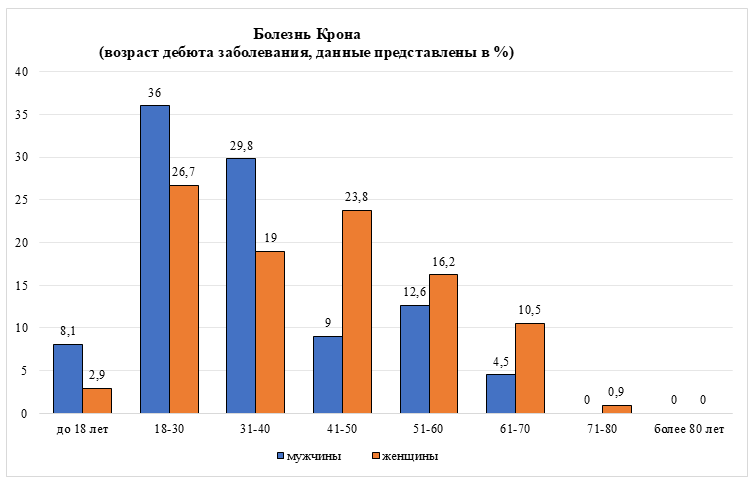 |
Fig. 2. Distribution of patients with inflammatory bowel diseases (ulcerative colitis (A) and Crohn’s disease (B)) by gender and age at the time of disease onset
Data (in %):
UC: men: <18 – 5%, 18–30 – 28.3%, 31–40 – 29.4%, 41–50 – 17.4%, 51–60 – 12.9%, 61–70 – 5.5%, 71–80 – 1%, >80 – 0.5%. Women: <18 – 4.3%, 18–30 – 34.1%, 31–40 – 22.8%, 41–50 – 15.7%, 51–60 – 13.7%, 61–70 – 6.3%, 71–80 – 3.1%, >80 – 0%.
CD: men: <18 – 8.1%, 18–30 – 36%, 31–40 – 29.8%, 41–50 – 9%, 51–60 – 12.6%, 61–70 – 4.5%, 71–80 – 0%, >80 – 0%. Women: <18 – 2.9%, 18–30 – 26.7%, 31–40 – 19%, 41–50 – 23.8%, 51–60 – 16.2%, 61–70 – 10.5%, 71–80 – 0.9%, >80 – 0%.
Time from onset of first symptoms to diagnosis was less than 2 years in 95.4% of UC patients (of which diagnosis within the first year was made in 67.2% of all UC patients in the registry). Diagnosis was made within 3–5 years in 3.7% of patients, and within 6–8 years in 0.9%.
In CD patients, the diagnosis was established within the first two years from the first clinical manifestations in 84.4% (of which diagnosis within the first year was made in 41.3% of all CD patients in the registry), 10.6% within 3–5 years, after 6–8 years – 2.3%, more than 8 years – 2.7%.
The mean time from first clinical manifestations to diagnosis, according to the PR IBD registry, was 0.8 years (9.6 months) for UC and 1.52 years (18.3 months) for CD.
Smoking status is present in 16.1% of IBD patients enrolled in the PR IBD registry. UC patients confirmed smoking in 14.8% of cases, CD patients in 18.8% (13.8% currently smoke, 5% smoked previously).
Ulcerative colitis: the extent of involvement in UC is assessed according to the Montreal classification [7]: distal colitis (proctitis) – E1, left-sided colitis – E2, and extensive colitis (pancolitis) – E3. According to the PR IBD registry, among UC patients the most common is extensive involvement (E3), followed by left-sided involvement (E2) and proctitis (E1) (Fig. 3).
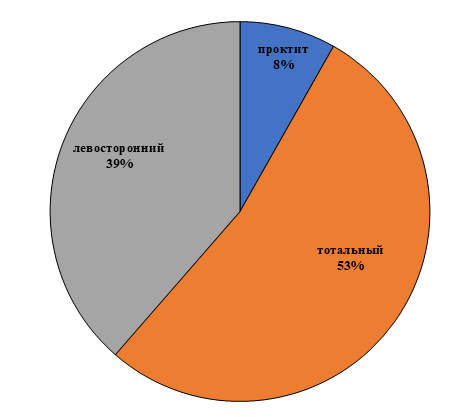
Fig. 3. The extent of inflammation in ulcerative colitis in patients with ulcerative colitis in Primorsky Region (Montreal classification)
Data: Proctitis (E1) – 8.2%, left-sided (E2) – 38.8%, extensive (E3) – 53.0%.
According to the course of ulcerative colitis, acute course is present in 16.7% of patients in the PR IBD registry; chronic continuous relapsing (remission less than 6 months on adequate treatment) – 18.5%; chronic relapsing – 64.8%.
Disease severity is generally defined as a combination of disease manifestations: severity of the current attack, presence of extraintestinal manifestations and complications, and refractoriness to treatment (steroid dependence or resistance) [8].
According to the severity of ulcerative colitis, patients in the PR IBD registry are distributed as follows: mild course – 42.4%, moderate course – 48.5%, severe UC – 9.1%.
Crohn’s disease: CD localization is assessed according to the Montreal classification [7]. The majority of patients have colonic involvement: ileocolitis L3 and colitis L2 (see Fig. 4). There were significantly more such patients (p <0.05) than patients with terminal ileitis L1. Localizations in the jejunum, upper gastrointestinal tract (L4) were not isolated, they were observed in combination with the three main types.
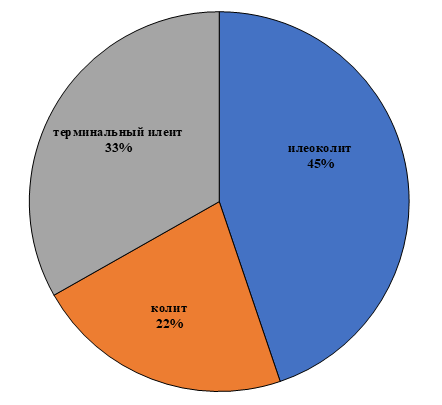
Fig. 4. Localization of Crohn’s disease in patients in Primorsky Region (Montreal classification)
Data: Terminal ileitis (L1) – 18.6%, Colitis (L2) – 20.5%, Ileocolitis (L3) – 54.1%, Upper GI involvement (L4) – 6.8% (in combination with others).
Perianal lesions in 17.4% of CD patients were registered in combination with involvement of the terminal ileum or colon; none were isolated.
CD phenotype: according to the PR IBD registry, the inflammatory (luminal, non‑penetrating) form of CD is observed in 67.1% of patients, strictures are registered in 21.8%, penetrating form in 8.3% of cases. Combination of fistulas and strictures (mixed phenotype) was noted in 2.8% of CD patients.
Extraintestinal manifestations (EIMs) in IBD were registered in 33.6% of all IBD patients. At the same time, EIMs were statistically significantly more common (p <0.001) in CD patients (47.1%) than in UC (27.2%). Types of EIMs and their frequency are presented in Table 1, statistical significance in Table 2.
Table 1. Types of extraintestinal manifestations and frequency of occurrence in IBD patients in Primorsky Region (absolute numbers)
| Localization | Crohn’s disease (n=218) | Ulcerative colitis (n=464) |
|---|---|---|
| Joints and spine | 40 | 58 |
| Skin and mucous membranes | 21 | 24 |
| Eyes | 5 | 4 |
| Liver involvement | 7 | 13 |
| Anemia | 19 | 24 |
| Thyroid gland | 1 | 15 |
| Other localizations | 7 | 7 |
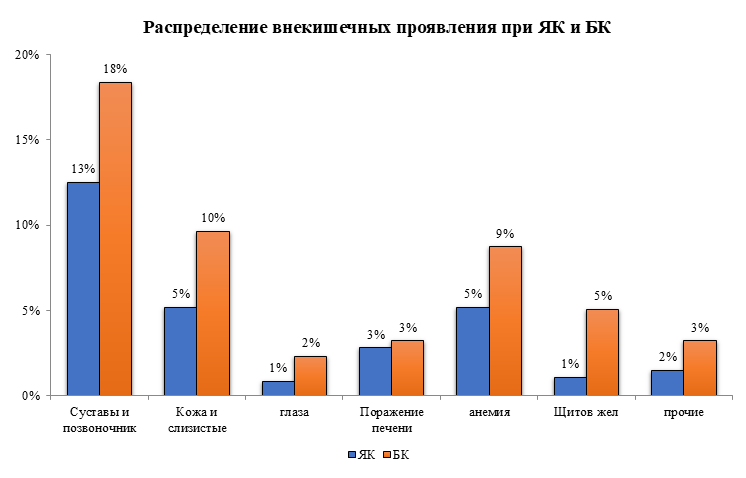
Fig. 5. Extraintestinal manifestations of ulcerative colitis and Crohn’s disease in patients with inflammatory bowel disease in Primorsky Region
(Figure 5 illustrates the distribution of EIMs; data correspond to Table 1.)
Table 2. Probability of occurrence of extraintestinal manifestations in inflammatory bowel diseases
| Parameter | Joints and spine | Skin and mucous membranes | Eyes | Liver involvement | Anemia | Thyroid gland |
|---|---|---|---|---|---|---|
| χ² value | 4.123 | 4.788 | 2.334 | 0.087 | 3.152 | 10.195 |
| Significance level (p) | 0.043* | 0.029* | 0.127 | 0.768 | 0.076 | 0.002* |
Note: * – p <0.05, statistically significant.
Treatment of IBD according to the PR IBD registry (Fig. 6). Therapy with 5-aminosalicylates (5-ASA) in various forms and doses is received by 87% of patients with ulcerative colitis and 44.5% with Crohn’s disease (as monotherapy, 5-ASA in 53.4% of UC cases and 22% in CD). Combination of 5-ASA and thiopurines in 32.5% of UC and 18.3% of CD. Thiopurines as monotherapy were used in 3% of UC patients and 41.3% of CD patients. Overall, thiopurines were used as maintenance therapy in 35.5% of UC patients and 59.6% of CD patients.
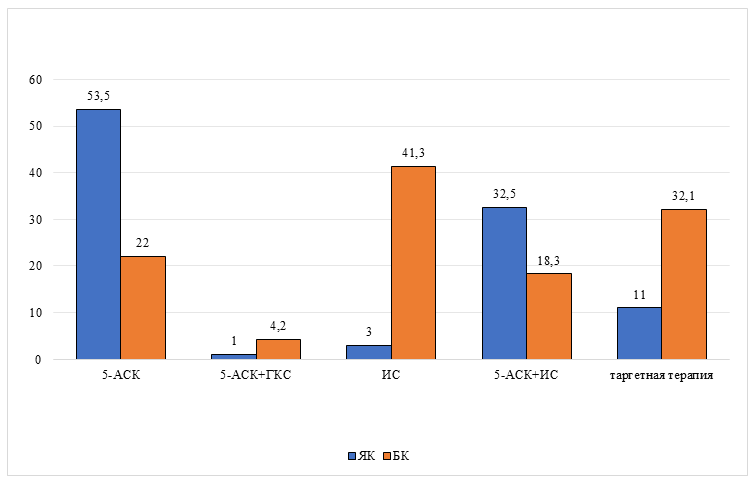
Fig. 6. Treatment of inflammatory bowel diseases in Primorsky Region according to the registry of inflammatory bowel diseases in Primorsky Region
Data (% of patients with the respective nosology):
UC (n=464): 5-ASA mono – 53.4%, 5-ASA + thiopurines – 32.5%, thiopurines mono – 3.0%, targeted therapy – 11.0%, corticosteroids (short courses) – 28.9%, corticosteroids (3–4 courses) – 6.5%, prolonged corticosteroids – 1.0%.
CD (n=218): 5-ASA mono – 22.0%, 5-ASA + thiopurines – 18.3%, thiopurines mono – 41.3%, targeted therapy – 32.1%, corticosteroids (short courses) – 61.0%, corticosteroids (3–4 courses) – 4.6%, prolonged corticosteroids – 4.2%.
The use of systemic and topical glucocorticosteroids (GCS) is carried out according to clinical guidelines, for induction of remission. According to the PR IBD registry, 1–2 courses of GCS in 28.9% of UC patients, and 3–4 courses in 6.5% of UC. In CD, 61% and 4.6%, respectively. Prolonged therapy including GCS is received by 14 people (2% of all IBD patients). All these patients have concomitant autoimmune pathology or other indications for long-term GCS use (systemic lupus erythematosus, rheumatoid arthritis, autoimmune hepatitis, transplanted kidney); in UC 1% of cases, in CD 4.2% (GCS with azathioprine 2.8%, GCS and targeted therapy 1.4%).
Targeted therapy, including genetically engineered biological agents (GEBAs) and selective immunosuppressants, is received by 121 patients in Primorsky Region (17.75% of PR IBD patients). In UC, targeted therapy is prescribed to 51 patients (42.1% of all patients on this therapy in PR and 11% of all UC patients in PR), in CD to 70 people (57.9% of all patients on this therapy in PR and 32.1% of all CD patients in Primorsky Region). Detailed data (as of November 2025) are presented in Fig. 7.
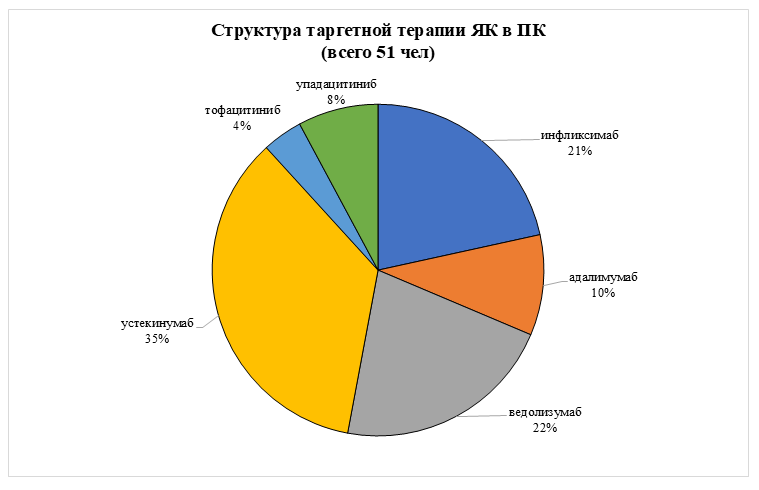 | 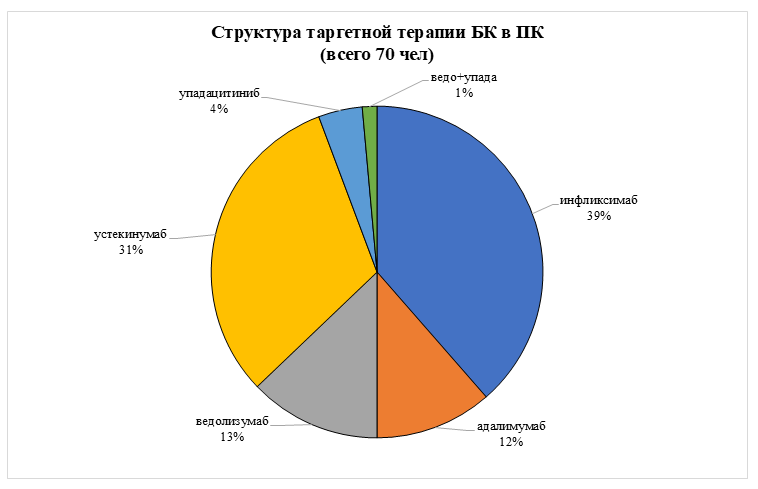 |
Fig. 7. Structure of targeted therapy by international nonproprietary name for ulcerative colitis (A) and Crohn’s disease (B) in Primorsky Region
Data for UC (51 people): Infliximab – 58%, Adalimumab – 2%, Golimumab – 4%, Ustekinumab – 10%, Vedolizumab – 18%, Tocilizumab – 2%, Rituximab – 2%, Abatacept – 2%, Others – 2%.
Data for CD (70 people): Infliximab – 41%, Adalimumab – 20%, Golimumab – 6%, Ustekinumab – 17%, Vedolizumab – 10%, Tocilizumab – 3%, Rituximab – 1%, Abatacept – 1%, Others – 1%.
This registry is largely hospital‑based, which limits information about outpatients followed outside the PR IBD center. The PR IBD registry is not a “live tool”; there is no possibility of automatic data entry for newly diagnosed cases. The labor‑intensive maintenance of the registry is carried out outside working hours, which the authors also consider a limitation.
According to the results of the largest study “Global Burden of Disease 2019” (GBD) from 1990 to 2019, which included data from 204 countries and territories, an increase in the total number of prevalent IBD cases was observed in most GBD regions [9]. Summary data on the incidence and prevalence of IBD in the Russian Federation are lacking [10]; there is no unified national IBD patient registry, so the increase in IBD incidence can only be indirectly judged by the increase in hospitalizations for ICD‑10 codes K50 and K51 [10]. Previous studies on IBD epidemiology ESCApe, ESCApe-2, INTENT [3, 4] evaluated the epidemiology of UC and CD in selected regions of Russia, also including Kazakhstan and Belarus. Data from individual regional IBD registries differ significantly: in the Moscow region, the prevalence of IBD is 60.7 per 100,000 population, in Irkutsk 74.9 per 100,000, and in the Republic of Tatarstan 40 per 100,000 [1, 3, 4].
The UC:CD ratio differs: in Primorsky Region it is 2.1:1, according to the North‑Western IBD Treatment Center it is 1.43:1 [11], in patients with UC and CD living in Chelyabinsk and Chelyabinsk Region it is 5.2:1 (data from 2019) [12]. According to the literature, in developed countries this ratio approaches 1, while in Asian countries the proportion of UC exceeds CD by 2 or more times [5, 6].
In Primorsky Region, hospitalized morbidity according to the report of the PR SAHI “MIAC” for ulcerative colitis was 22.3 per 100,000 population in 2022 and 30.0 per 100,000 in 2024, an increase of 34.5%; for Crohn’s disease, the figures for the same periods were 23.6 and 26.5, respectively, an increase of 12.3%. A full study of Russian epidemiological indicators may become available with the creation and continuous updating of a national IBD Registry [1].
The age of disease onset is important for determining the prognosis of the disease and influences the choice of treatment strategy. The data from our registry (39.2 years for UC and 37.5 years for CD) correspond to the global trend [1, 3–6].
An important criterion for the possibility of modifying the disease course is the time from first symptoms to diagnosis: in Primorsky Region, the mean time to diagnosis for UC is 0.8 years (9.6 months), for CD 1.52 years (18.3 months). According to published studies from major Russian centers, the mean time from symptom onset to IBD diagnosis ranges from 2.5 to 3.5 years (mean 34.8 months) for CD and from 1 to 1.5 years (mean 13.2 months) for UC [1, 8, 13]. The shorter times compared to the national average are likely due to active education of general practitioners and gastroenterologists, frequent telemedicine consultations (TMC) with districts of the region, referral of patients to the regional IBD center for therapy selection, and remote monitoring of patients after IBD diagnosis. Late diagnosis leads to increased extent of involvement in UC, a greater number of severe IBD manifestations, the appearance of EIMs, and the development of complications in CD and UC.
The delay in diagnosing IBD, especially CD, is associated with diagnostic difficulties: there are not always clinically obvious manifestations of the disease, there are periods of apparent “well‑being”, which reduces patient vigilance and delays the visit to a doctor. Localizations of involvement outside the colon are difficult to diagnose. Colonoscopy with mandatory examination of the terminal ileum is recommended; if jejunal involvement is suspected, CT or MR enterography should be performed.
The relatively small number of patients with ulcerative proctitis (8.2% of all UC patients) is presumably due to the fact that these are mostly outpatients with mild disease who receive local therapy with good effect. However, without proper control and inadequate therapy, disease progression and increased extent of inflammation may occur.
The results of the PR IBD registry for CD correspond to the data for Russia obtained in the previously conducted ESCApe, ESCApe-2, and INTENT studies [3, 4].
During the study, a clinical and demographic analysis of the IBD patient registry of Primorsky Region was performed using a self‑developed form. The registry can be considered an effective tool for pharmacoepidemiological analysis: assessment of IBD epidemiological indicators in Primorsky Region [14] allows monitoring of therapy outcomes in real‑world clinical practice. This, in turn, allows planning of drug supply volumes.
The potential of the IBD patient registry of Primorsky Region for systematizing IBD features, EIMs, monitoring the efficacy and safety of maintenance therapy is quite high. The information in the registry allows evaluation of IBD course and the effectiveness of various treatment methods. Data analysis enables pharmacoeconomic calculations. The registry is a valuable tool for assessing epidemiological and clinical data and the types of treatment used. The introduction of a unified form and the ability to record data at the Russian Federation level, the formation of a federal registry, could reveal the true picture of IBD in the country.
The development of the registry will allow updating data on IBD epidemiology. Using registry data, physicians and healthcare organizers can improve patient care, optimize budget expenditures when purchasing drugs for IBD patients, and plan their rational use.
We plan to continue building the IBD registry of Primorsky Region using data from the Unified Medical Information System, conducting telemedicine consultations with districts of the region, online monitoring and counseling of patients discharged from the hospital regarding emerging treatment issues.
1. Belousova E.A., Shelygin Yu.A., Achkasov S.I., et al. Clinical and Demographic Features and Treatment Approaches for Inflammatory Bowel Diseases (Crohn’s Disease, Ulcerative Colitis) in the Russia. The Primery Results of the Analysis of the National Register. Koloproktologia. 2023;22(1):65-82.
2. Turner D, Ricciuto A, Lewis A, et al; International Organization for the Study of IBD. STRIDE-II: An Update on the Selecting Therapeutic Targets in Inflammatory Bowel Disease (STRIDE) Initiative of the International Organization for the Study of IBD (IOIBD): Determining Therapeutic Goals for Treat-to-Target strategies in IBD. Gastroenterology. 2021 Apr;160(5):1570-1583. doi: 10.1053/j.gastro.2020.12.031.
3. Belousova EA, Abdulganieva DI, Alexeeva OP, et al. Social and demographic characteristics, features of disease course and treatment options of inflammatory bowel disease in Russia: results of two multicenter studies. Almanac of Clinical Medicine. 2018;46(5):445-463. (In Russ.)
4. Knyazev OV, Belousova EA, Abdulganieva DI, et al. Real world practice of medical treatment for moderate and severe inflammatory bowel diseases in Russian Federation, Republic of Belarus and Republic of Kazakhstan: intermediate results of the INTENT study. Almanac of Clinical Medicine. 2021;49(7):443-454. (In Russ.)
5. Simian D, Fluxá D, Flores L, et al. Inflammatory bowel disease: A descriptive study of 716 local Chilean patients. World J Gastroenterol. 2016 Jun 14;22(22):5267-75. doi: 10.3748/wjg.v22.i22.5267.
6. Ye Y, Pang Z, Chen W, et al. The epidemiology and risk factors of inflammatory bowel disease. Int J Clin Exp Med. 2015 Dec 15;8(12):22529-42.
7. Silverberg MS, Satsangi J, Ahmad T, et al. Toward an integrated clinical, molecular and serological classification of inflammatory bowel disease: report of a Working Party of the 2005 Montreal World Congress of Gastroenterology. Can J Gastroenterol. 2005 Sep;19 Suppl A:5A-36A. doi: 10.1155/2005/269076.
8. Shelygin Yu.A., Ivashkin V.T., Belousova E.A., et al. Ulcerative colitis (K51), adults. Koloproktologia. 2023;22(1):10-44.
9. GBD 2019 Mental Disorders Collaborators. Global, regional, and national burden of 12 mental disorders in 204 countries and territories, 1990-2019: a systematic analysis for the Global Burden of Disease Study 2019. Lancet Psychiatry. 2022 Feb;9(2):137-150. doi: 10.1016/S2215-0366(21)00395-3.
10. Maev IV, Shelygin YuA, Skalinskaya MI, et al. The Pathomorphosis of Inflammatory Bowel Diseases. Annals of the Russian Academy of Medical Sciences. 2020;75(1):2735 (In Russ.) DOI:10.15690/vramn1219.
11. Bakulin I.G., Skalinskaya M.I., Skazyvaeva E.V. North-Western register of patients with inflammatory bowel diseases: achievements and lessons learned. Koloproktologia. 2022;21(1):37-49. (In Russ.)
12. Dolgushina AI, Khusainova GM, Vasilenko AG, Kononets VA. Prevalence of inflammatory bowel disease in the Chelyabinsk Region. Almanac of Clinical Medicine. 2019;47(6):511-517. (In Russ.)
13. Shelygin Yu.A., Ivashkin V.T., Achkasov S.I., et al. Clinical guidelines. Crohn’s disease (К50), adults. Koloproktologia. 2023;22(3):10-49.
14. Maneeva E.S., Eliseeva E.V. Clinical and economic analysis of the medicinal nomenclature for preferential categories of citizens. Pacific Medical Journal. 2016;61(4):84-86. (In Russ.)
Alexandra S. Moskalenko — postgraduate student, Department of General and Clinical Pharmacology; gastroenterologist, Department of Gastroenterology
Vladivostok
The authors state that there is no conflict of interest
Ekaterina V. Eliseeva — PhD, Dr. Sci. (Med.), Professor, Head of Department of General and Clinical Pharmacology
Vladivostok
The authors state that there is no conflict of interest
Olga V. Chesnokova — Chief Gastroenterologist of the Primorsky Krai Ministry of Health, Head of the Gastroenterology Department
Vladivostok
The authors state that there is no conflict of interest
Oksana V. Perelomova — Senior Lecturer at the Institute of Fundamental Principles and Information Technologies in Medicine
Vladivostok
The authors state that there is no conflict of interest
Moskalenko A.S., Eliseeva E.V., Chesnokova O.V., Perelomova O.V. Registry of patients with inflammatory bowel diseases: clinical, demographic and pharmacoepidemiological aspects. Kachestvennaya Klinicheskaya Praktika = Good Clinical Practice. 2026;(1):78-88. (In Russ.) https://doi.org/10.37489/2588-0519-GCP-0016. EDN: NKOAQU
НАШИ КНИГИ



Другие журналы
"Издательства ОКИ"


ПАРТНЕРЫ

 Email this article (Login required)
Email the author (Login required)
Email this article (Login required)
Email the author (Login required) 121357, Moscow, st. Vatutina, 4, building 2, apt. 22
LLC Publishing House OKI
Tel. +7 (926) 568-17-35
e-mail: clinvest@mail.ru


